Deciding whether my meal is more of a problem or solution is actually quite difficult. In many ways, I find it to be both. Still, if I were to choose just one, overall my meal was probably more of a problem.
We should all garden like Winnie the Pooh!
The reason I would consider some of it a solution is because of the green beans that came from my mother's garden. Along with coming from her garden, the waste actually went back into it by way of her compost. By growing them in our own backyard, we're doing it on a much smaller scale, versus the large agricultural farms that exist which can cause many issues with products like pesticides or even with soil erosion. If everyone had their own garden and supplied their own produce, or at least some of it, I believe it could make a huge difference in the way this country's agriculture works. Still, I understand that everyone supplying their own fruits and vegetables isn't truly feasible as a) not everyone wants to do that and b) not all climates will allow it. But I still believe having personal garden's is a benefit to the environment.
As for the problems with my meal, many of them come from ingredients that I didn't actually discuss in the last post but, as they were still a part of my meal, they still count. I think many of the problems relate to the solutions I found in the green beans, namely the fact that they were locally (home) grown. I think our food industry has become something of a machine itself these days, cranking out mass amounts of a food and not always in the healthiest or most environmentally conscious way either (the most relevant example I can think of would be the meat industry). Although it is nice to have strawberries from California in the winter when we can't grow them here in Wisconsin, there are many other aspects about having such an interconnected, commercial food industry that I believe cause more problems than good. It becomes a matter of the amount that can be produced rather than the quality, which leads to things like pesticides and corn-fed cows. Also, it leads to the large amount of machinery involved with harvesting the food and transporting it across the nation, using even more fossil fuels.
From my understanding, one of the best solutions to this is to buy locally grown foods and support your local farmers (I've found that one of the easiest ways to do this is by attending the farmer's market). I think the commercial agriculture industry will continue working the way it does now until individuals decide to make a change by buying different products (myself included!). And, of course, there are many many other factors involved, making the solution much more complicated than just buying local foods. However, I think the solution truly starts with the individual. If each individual buys locally or has his or her own garden for example, it will eventually affect the local community and hopefully someday, will affect the entire nation.
The thought “where does this food come from?” has crossed my mind many times before. However, I very often stop myself from finding the answer because I don’t think I ever truly want to know. Still, taking this class has given me the tools to think globally about my meal and the impacts it has around the world.
After a little bit of research, including on the grocery store website, I found it kind of difficult to discover where the ingredients were grown. In the vegetable salad, I know that the green beans actually came from my mother’s own garden in our back yard. As for the carrots, which before being cut up were actually ‘baby carrots,’ I have learned that the majority of carrots in the United States are grown in California; these carrots, of Bolthouse Farms, were grown in Bakersfield, California. Once again, the strawberries in the fruit salad were also likely grown in California, though they could have also been from Florida or possibly even Oregon. The only thing I learned from the actual grocery store website was that they “pride themselves on supporting the local Wisconsin farmers in our communities,” so, in terms of the strawberries, they may have even come from Wisconsin!
When thinking about the environmental impacts of each ingredient, we’ll go with the easiest one first, which would be the green beans grown in my mother’s garden. Because they were grown on such a small scale, I do not believe that they would have drastically changed the biodiversity in my backyard. It had probably already been altered when the large structure that is my house was put there…
Anyway! In terms of water, I know my mother uses the hose attached to our house to water her plants, so though it is not necessarily directly affecting groundwater or surface water, it is in other ways. I do believe there were any fossil fuels involved in the process (I sincerely hope not) and I also do not believe that the small amount of green beans grown in her garden are contributing immensely to carbon dioxide emissions. I think most of the impacts would be local, though if she used any pesticides, those effects could become global.
For the other two ingredients, many other factors are involved, particularly for the carrots. For this purpose, let’s assume that the strawberries came from California. As a part of agriculture, both the carrots and the strawberries impact groundwater and surface water in many ways. After all, agriculture in California uses 85% of the water supply, mostly through irrigation. Because they are both grown on such large plots of farmland, the original habitat of that area was changed drastically to become agricultural land, consequently reducing the biodiversity as well. Chemicals, such as pesticides were likely used on both ingredients as well as fossil fuels in indirect ways. Although, according to the California Strawberries, strawberries are picked by hand, the carrots are picked by large agricultural machines, running on gasoline/oil. This doesn’t even cover the entire factory process that regular carrots go through to become what Americans know as ‘baby carrots.’ Much more than the green beans, I think the effects of carrots and of strawberries can be considered local as well as global. The soil erosion from the agricultural lands as well as the pesticides and chemicals used are some of the leading sources of water pollution, which can have negative impacts around the world.
The trip for the green beans, an ingredient I would consider local, was considerably shorter than the trip for the carrots and strawberries. As the former two were bought in supermarkets, they likely ended up there by truck and were ultimately transferred to the house by a rockin’ minivan. The food waste of the green beans actually went into my mother’s compost bin, which will eventually end up back in her garden. The carrots and strawberries both came in plastic, which was likely thrown away and will end up in a landfill (and take 1000 years to decompose…).
It was most definitely a challenge to think about the global impacts of even just a few ingredients in my meal. If everyone knew the entire story of where his or her food came from, I think it would have a major impact on the way we buy/produce our food, hopefully in a positive way.
As a college student without many skills or enough patience in the kitchen, I must admit that, typically, my meals do not consist of a variety of foods. With that said, I believe the last "real meal" I had was when I went home for my sister's college graduation in June. Sad, I know.
Anyway! I this is what I ate...
We had plain grilled chicken, fruit salad, vegetable salad and quiche. The fruit salad was a little different than most; it consisted of strawberries, kiwi, cantaloupe and noodles. Yes, bow-tie noodles. The entire salad was covered in a dressing made with sugar, poppy-seeds, vinegar, oil and orange juice. It sounds a little strange, but it was actually quite good!
(Something similar to this salad...)
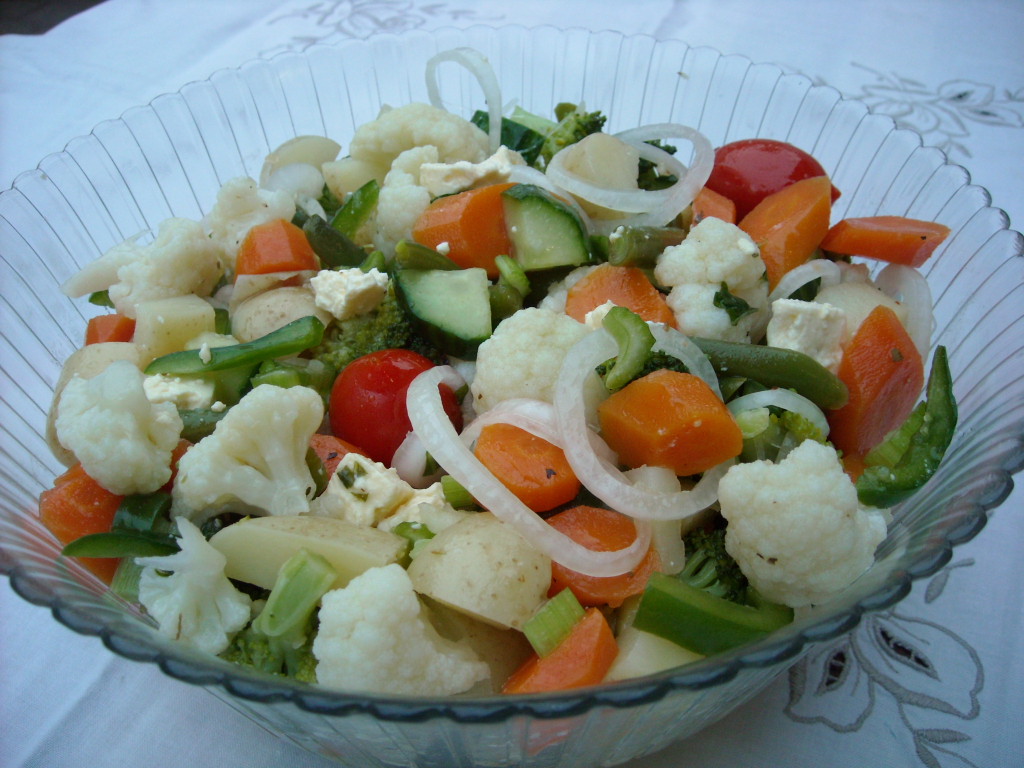
In the vegetable salad, there were green beans, carrots, red onions, red peppers and cauliflower. This was covered in a dressing made with oil, vinegar and oregano.
And finally, we had a quiche. It was made with eggs, cream, milk, spinach, bacon, cheese and baked in a wheat-butter crust.
Plastic bags have become a symbol of American Consumerism: a tool that is easy to use and even easier to throw away. The easiest part being that, in America, we hardly ever have to see the results of our consumerist society first-hand. Nevertheless, plastic bags are becoming a hazard to the environment and people all over the world.
There were many surprising, and shocking, things I found in the video. It truly made me think because in my own apartment, my roommates and I seem to own what feels like a record number of plastic bags; we have drawers and shelves full of them, and the number only seems to keep growing. As a country, we go through billions every year, most of which just end up in landfills, decomposing for anywhere from 400 to 1000 years. It was disturbing to see the effects of plastic bags in other countries such as Kenya and India and, although we may not feel those effects directly, they very much affect the environment and therefore the world as a whole. This made me think about all the plastic bags I have thrown away just in the hopes of shrinking our growing pile. Though I cannot explicitly see the effects my action, I now know/realize the damage that it can have. It also made me curious about the possibilities of recycling plastic bags in Milwaukee. I know the curbside recycling system in Milwaukee does not accept them; however, a small number of businesses do. Now I know of a better way to get rid of the massive amount of plastic bags I have acquired.
But what I found most interesting is the substance from which plastic bags are made. When the question was posed in the documentary, I was slightly ashamed that I couldn’t answer it, and I was even more shocked to learn they come from oil. Because oil is a fossil fuel that is depleting, this not only has local effects, but also worldwide impacts.
I was particularly impressed with the woman from the small town in England for her method of solving plastic bag waste. Simply by showing a documentary to local business owners, she was able to completely change her town’s habits and relationships to plastic bags, removing them from the picture altogether. Other places, such as Mumbai, India, are taking legal action, banning thin plastic bags completely and giving heavy fines to businesses for possessing them.
In my opinion, the issue of plastic bags needs to be dealt with locally first. I believe that if it is dealt with in local areas, then eventually taking action on a global scale may be easier or more effective. I understand that completely shutting down the plastic bag industry is highly improbable, but educating people about recycling and the damaging effects of plastic bags as well as setting up better recycling systems may help to limit the large amount we use and waste. Another option would be to take legal action, like in San Francisco. If implemented in the right way, it could have more positive effects than simply hoping that people will recycle. No matter the pathway, I do believe that plastic bag waste is an issue that we should all be concerned about and something we should all take action to change.

 As for the problems with my meal, many of them come from ingredients that I didn't actually discuss in the last post but, as they were still a part of my meal, they still count. I think many of the problems relate to the solutions I found in the green beans, namely the fact that they were locally (home) grown. I think our food industry has become something of a machine itself these days, cranking out mass amounts of a food and not always in the healthiest or most environmentally conscious way either (the most relevant example I can think of would be the meat industry). Although it is nice to have strawberries from California in the winter when we can't grow them here in Wisconsin, there are many other aspects about having such an interconnected, commercial food industry that I believe cause more problems than good. It becomes a matter of the amount that can be produced rather than the quality, which leads to things like pesticides and corn-fed cows. Also, it leads to the large amount of machinery involved with harvesting the food and transporting it across the nation, using even more fossil fuels.